
September 30, 2026
If Your Best Tech Called in Sick Tomorrow, Would Your Rooms Still Be Ready?
How OneLight connects illuminated tools, procedure staging, point-of-use guidance and education before care begins
Expert perspective informed by Owen Dahl, MBA, LFACHE, CHBC, LSSMBB, medical practice management consultant and MGMA member
Urgent care needs a connected approach
If the answer depends on who is working that day, readiness has become a memory problem – something individual staff carry in their heads instead of a process the entire team can rely on. Schedules, staffing assignments and room availability change throughout the day. A patient may arrive with an ear complaint, a nasal foreign body or another condition that requires the team to move from assessment to a procedure. The tools may be available somewhere in the center, but availability alone does not establish readiness.
Clinical readiness depends on several elements working together. Clinicians need the appropriate procedural tool and illumination at the point of care. Staff need to know which products to prepare, where those products belong and how they will move to and from the exam room. The team also needs access to procedural instruction and practical guidance. When those elements are treated as separate decisions, preparation can vary by room, procedure or staff member.
OneLight™ began as an illumination platform and, with ReadyHub™, is evolving into a procedural readiness ecosystem. The ecosystem connects compatible lighted tools, the OneLight Rechargeable Light Source, the ReadyHub Procedure Staging System, Procedure Preparation & Billing Cards and Bionix Clinical Education. Together, these elements extend the OneLight story from the tool used during a procedure to the preparation that begins before it.
One light source, every compatible tool
OneLight integrates illumination directly into compatible ear, nose and throat procedural tools, so the light moves with the instrument. The OneLight Rechargeable Light Source provides illumination across compatible lighted tools, allowing clinicians to select the tool appropriate for the application while continuing to use a familiar light source. In Bionix Technical Report QCR-00113, the evaluated lighted tools were over 22% more efficient than the evaluated non-lighted alternatives under the study conditions.[1]
That finding reinforces the role of integrated illumination during the procedure. ReadyHub builds on that foundation by connecting illumination with the staging, guidance and education that surround the procedure.
How it all works together
The OneLight Ecosystem connects five parts of procedural readiness:
Integrated illumination. The OneLight Rechargeable Light Source brings illumination directly to the procedure site across compatible lighted tools.
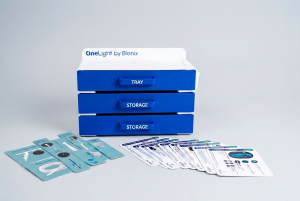
Procedure staging. The ReadyHub Procedure Staging System gives compatible OneLight tools, Rechargeable Light Sources and accessories a defined home.
Point-of-use preparation guidance. Procedure Preparation Cards show care teams which compatible products to stage for supported procedures.
Product education. Bionix Clinical Education provides product instruction, procedural demonstrations and practical guidance for clinicians and staff.
Room to grow. Compatible applications, refills and future OneLight innovations can build on the same illumination and preparation approach as procedural needs evolve.
Within the ecosystem, these components work together across preparation and care. Procedure Preparation Cards identify what to stage, while ReadyHub provides a defined location and removable caddy. Staff use the caddy to carry selected products to the exam room, then return it to its defined home after use. At the point of care, the compatible tool and OneLight Rechargeable Light Source provide illumination. Bionix Clinical Education offers additional product instruction and procedural guidance.
Explore the OneLight Ecosystem for Procedural Readiness
A process staff can see and repeat
Owen Dahl, a medical practice management consultant with extensive experience in Lean Six Sigma, applies a human-centered perspective to process improvement. His work emphasizes that a process must make sense to the people expected to follow it.[2]
“An effective system should make the next step clear to the team member doing the work. When tools, guidance and education are connected, staff have a process they can learn and repeat instead of relying on individual memory.”
~ Owen Dahl, MBA, LFACHE, CHBC, LSSMBB
That principle is especially relevant in urgent care, where the person preparing for a procedure may vary by shift or room. A visible process gives the team a common reference. The ReadyHub Procedure Staging System and Procedure Preparation Cards support a simple sequence: stage the identified products in the caddy, carry them to the exam room, return the caddy after use and use the stocking cues as a reference for replenishment.
Standardization does not mean every patient or procedure is handled identically. Clinical judgment still determines what is appropriate for the patient. The preparation model establishes where compatible products belong and how they are prepared so that staff do not have to recreate the process each time.
Build around the procedures your center performs
Urgent care centers vary in the patients they serve and the procedures they perform most often. The OneLight Ecosystem allows each center to begin with the illuminated tools and preparation resources most relevant to its needs. As procedure needs evolve, compatible tools and refills can be added while the OneLight Rechargeable Light Source and preparation model remain familiar.
This approach does not require every center to prepare for every supported application. Teams can identify the procedures they perform, determine which products should be readily available and establish a consistent method for staging and replenishment. This creates a preparation process grounded in the center’s actual patient and procedure mix.
Procedure Preparation Cards bring relevant guidance closer to the point of preparation. Each card identifies the compatible products associated with a supported procedure and includes commonly associated CPT and ICD-10-CM references.[3]
Urgent care leaders evaluating the economics of illumination can also use the OneLight ROI Calculator on bionix.com. The calculator uses procedure volume and stated assumptions to estimate illumination costs and potential payback based on the information entered. Results should be considered in the context of the center’s product configuration, pricing and procedure mix.
See How Ready Your Team Is – Take the Workflow Assessment
A connected approach to procedural readiness
Compatible lighted tools and the OneLight Rechargeable Light Source remain central to the ecosystem. The OneLight ReadyHub Procedure Staging System, Procedure Preparation Cards, Billing Information and Clinical Education extend OneLight to the preparation surrounding the procedure.
For urgent care teams, these connected resources provide a consistent way to prepare the appropriate products, move them to the point of care, support visualization during the procedure and return to readiness afterward. Each component serves a distinct purpose within the same preparation model.
Procedural readiness begins before the procedure. By connecting illumination with staging, preparation guidance and education, the OneLight Ecosystem gives urgent care centers an approach they can apply to the procedures and products relevant to their patient mix. Additional compatible tools and applications can be incorporated as needs evolve while the preparation process remains familiar.
Sources
Bionix Technical Report QCR-00113. The greater-than-22% efficiency finding is limited to the lighted tools, non-lighted alternatives and study conditions evaluated.
Medical Group Management Association. Owen Dahl, MBA, LFACHE, CHBC, LSSMBB, member and consultant profile. Source
Billing and coding information is provided for general reference only. Code selection and reimbursement depend on patient documentation, medical necessity, payer policy and care setting. Coverage and payment are not guaranteed.
