
November 3, 2026
In a hospital, an electrical outlet isn’t just an outlet – it’s the connection point for ventilators, infusion pumps and monitoring equipment that can’t afford a gap in power. Regular receptacle testing isn’t paperwork – it’s a documented safeguard against equipment failure, and it’s exactly what surveyors check first during a Life Safety Code inspection.
What the Code Actually Requires
Under NFPA 99, receptacle testing in patient care areas (§6.3.3.2) requires four specific checks on every outlet:
Visual inspection of physical integrity
Grounding circuit continuity
Correct polarity of hot and neutral connections
Retention force of the grounding blade (minimum 4 oz.)
One detail most facilities – and most vendor content – gets wrong: NFPA published a 2024 edition of NFPA 99, but CMS still enforces the 2012 edition (incorporated by reference at 42 CFR 482.41, with Tentative Interim Amendments 12-2 through 12-6). That’s the version a surveyor cites against. Knowing which edition you’re actually accountable to – not just the newest one – is the difference between a clean survey and a documentation gap.
Why This Matters Beyond the Checkbox
Patient safety. A faulty receptacle doesn’t fail loudly – it fails quietly, under load, at the moment equipment needs it most. Testing catches integrity and grounding issues before they become a bedside emergency.
Survey and accreditation risk. As of January 1, 2026, The Joint Commission consolidated its Environment of Care and Life Safety chapters into a single Physical Environment (PE) chapter under its “Accreditation 360” restructuring. Utility systems management – where receptacle testing documentation is reviewed – now falls under PE.04.01.03. The substance hasn’t changed (NFPA 99, 2012 edition, is still the enforced standard), but the numbering has, and outdated citations are an easy tell that a facility’s compliance program hasn’t kept pace. The Joint Commission’s own June 2026 newsletter flagged inconsistent handling of electrical hazards – including missing outlet covers and unsecured electrical components – as a recurring survey observation.
The Joint Commission finds deficiencies in roughly 72% of hospital surveys – and the pattern isn’t unsafe facilities, it’s facilities that can’t prove they’re safe. Testing was performed but not documented per outlet. Inspections happened but records were unsigned or inconsistent. Missing or inconsistent outlet records remains one of the most avoidable deficiencies facilities generate: not testing enough, or testing without proper per-outlet documentation.
Operational continuity. Reactive outlet failures mean emergency electrician calls, equipment downtime, and disrupted care – costs that dwarf the time it takes to test proactively.
How the R7000 Simplifies Testing and Documentation
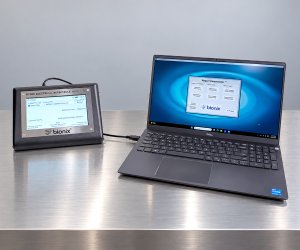
The Bionix R7000 Electrical Receptacle Analyzer helps healthcare facilities streamline NFPA 99 receptacle testing by performing up to 12 tests per receptacle, including wiring polarity, grounding, voltage and contact tension measurements.
Designed to simplify the testing process, the R7000 offers several key advantages:
Quickly identify failed receptacles. The R7000 performs tests in seconds and immediately displays an "OK" or "BAD" result on its touchscreen. Color-coded results help technicians identify receptacles that require further investigation or corrective action.
Reduce repetitive data entry. The touchscreen interface and preloaded room and outlet information allow technicians to move between locations without repeatedly entering the same information.
Store test results. The analyzer stores results for up to 10,000 receptacles, maintaining testing information for documentation and future reference.
Simplify reporting with Report Commander™ software. Test results transfer directly from the analyzer to a computer, where Report Commander generates formatted reports. Technicians can sort and filter results by location or test outcome, including identifying failed receptacles that require attention.
Support efficient testing throughout the facility. The portable analyzer and detachable Reference Cord provide flexibility for routine receptacle testing, comparative measurements and troubleshooting.
By combining automated testing, immediate identification of failed receptacles and Report Commander reporting capabilities, the R7000 helps healthcare facilities reduce manual testing and documentation tasks while maintaining organized records to support NFPA 99 compliance and accreditation reviews.
Frequently Asked Questions
How often must hospital outlets be tested?
NFPA 99 requires annual testing of non-hospital-grade receptacles in patient care areas. Hospital-grade receptacles require a documented facility risk assessment to determine testing frequency, which may extend beyond annual.
What happens if an outlet fails inspection?
The outlet must be replaced – typically with a hospital-grade receptacle – and the replacement documented on the inspection record.
Which NFPA 99 edition applies to my facility?
For CMS-regulated hospitals, the 2012 edition applies, not the current 2024 edition, until CMS formally adopts a newer version.
Did the Joint Commission’s 2026 restructuring change outlet testing requirements?
No. Accreditation 360, effective January 1, 2026, renumbered and consolidated Joint Commission standards but did not change the underlying NFPA 99 testing requirements. Utility systems oversight is now reviewed under PE.04.01.03 instead of the legacy EC.02.05.05.
Get Started
See how the R7000 Electrical Receptacle Analyzer simplifies receptacle testing, helps identify failed outlets and streamlines compliance documentation with Report Commander™ software. Contact Bionix today to request a demonstration or quote.
